
Montmorency County Arrest Records and Court Charges
A Montmorency County arrest record is the record of an arrest itself. It shows who was taken into custody, which agency made the arrest, and the booking that comes next. The Montmorency County Sheriff's Office, led by Sheriff Chad Brown, handles most local arrests and writes the incident and arrest reports. After an arrest, deputies lodge the person and a booking record is created. That booking detail sits on the custody side. The court charge record is a different file. It begins when the county prosecutor reviews the reports and files formal charges with the court, and from that point each charge is tracked through the case.
Two records grow from one arrest. The arrest and booking detail live on the custody side, and Montmorency County inmates are held at the Alpena County Correctional Facility, so the jail roster and booking data are covered on the inmate records page. The court charges after arrest live in the district or circuit court file. Each charge lists an offense, a statute, and a level of severity. The full case file, with pleas, hearings, and the final outcome, is laid out on the criminal court records page. Arrest records answer who was taken in. Charge records answer what the prosecutor actually filed.
How to Find Montmorency County Arrest Records
The arrest side and the charge side start in different places. Arrest and report information originates with the sheriff. The formal charges that follow are searched through the state court case portal. The Montmorency County Sheriff page is the starting point for the arrest side of the story.
The sheriff makes the arrest, but the charges that follow are found through the court case search, not the sheriff's site. Charges filed after a Montmorency County arrest appear in the MiCOURT public case search. The Montmorency Courts case-search page links the two local paths: the 88-2 District Court and the 26th Circuit Court. Use these steps.
- Open the Montmorency Courts case-search page and choose the correct court link.
- Pick 88-2 District Court for misdemeanors and early felony hearings, or the 26th Circuit Court for felonies after bindover.
- Search by the defendant's name or by the case number.
- Open the case and read the register of actions and the list of charges.
- Check each charge's statute, level, and current status.
The public search shows the register of actions, hearing dates, parties, counsel, case status, and financial history. It does not provide document copies, and it does not list nonpublic or suppressed cases. For a copy of a charging document, contact the court directly.
Who Files Montmorency County Court Charges
Police make the arrest. The prosecutor files the charges. In Montmorency County the charging decision belongs to Prosecutor Vicki P. Kundinger, with Assistant Prosecutor Luke Kwiatkowski. The Montmorency County Prosecutor's Office reviews the sheriff's reports and decides whether to file, what offense to allege, and at what level. An arrest alone does not create a charge. A charge exists only once the prosecutor files it with the court.
All adult criminal cases begin in the 88-2 District Court. The District Court Criminal Division explains the charges and rights at the first appearance, called the arraignment. For felonies, the case can then move up to the 26th Circuit Court after a preliminary examination finds probable cause. The prosecutor guides that path and may add, change, or withdraw charges as the case develops.
Filing Charges After a Montmorency County Arrest
The charge record begins with a charging document. This is the paper that names the offense and starts the criminal case in court. Michigan uses a complaint and an information for most felonies, tied together by the preliminary examination in District Court. A grand-jury indictment is possible but rare in a county this size. The table below sorts the three main types.
The Montmorency County Sheriff's Department website handles the arrest and report end of this process before any document reaches the prosecutor.

Once a report is complete, the prosecutor decides which document to file and at what level. The complaint and information carry most Montmorency felonies from the arrest through bindover.
| Complaint | Information | Indictment | |
|---|---|---|---|
| Filed By | Officer / Prosecutor | Prosecutor | Grand Jury |
| Common For | Misdemeanors and felony starts | Felonies after preliminary exam | Rare serious felonies |
| Role | Opens the case and states the offense | Formal felony charge for Circuit Court | Grand-jury accusation |
Charge Codes and Severity Levels
Every charge is tied to a Michigan statute and a severity level. The level tells you how serious the offense is and which court will handle the case. A misdemeanor is generally punishable by up to one year in jail and is handled in District Court. A felony is generally punishable by more than one year in prison and moves to Circuit Court after bindover. A civil infraction is not a crime at all and carries fines, not jail. One arrest can produce several separate charges, each with its own code, level, and status.
Reading a charge line means checking each of these parts.
- Offense description, such as the plain-language name of the crime.
- Statute cite, the Michigan law the charge is filed under.
- Severity level, marked as a felony, misdemeanor, or civil infraction.
- Count number, because one case can list many counts.
- Current status, which shows where the charge now stands.
Note: A single Montmorency County arrest can lead to felony, misdemeanor, and civil-infraction charges filed together in the same case, each tracked on its own line.
Charge Status in Montmorency County Cases
Charges are not fixed once they are filed. As a case moves, a charge can be amended, reduced, added, dropped, or dismissed. The prosecutor may change a charge after new facts, a plea deal, or a weak preliminary examination. Reading the status term next to each charge tells you whether it is still live and where it is going.
| Status | What It Means |
|---|---|
| Pending | The charge is filed and active, and the case is still open. |
| Amended / Reduced | The charge was changed, often lowered to a less serious offense. |
| Dismissed | The court dropped the charge, so it no longer moves forward. |
| Nolle Prosequi | The prosecutor chose not to pursue the charge and withdrew it. |
| Bound Over | A felony passed preliminary exam and moved up to Circuit Court. |
A dismissed or withdrawn charge can still appear in the public register of actions even after it ends. The record shows that the charge was filed and how it was resolved, which is why the status line matters as much as the charge itself.
Statewide Charge and Criminal History Lookups
Local court search covers Montmorency cases. A broader charge and criminal history picture comes from statewide systems. The Michigan Department of Corrections runs the Offender Tracking Information System, known as OTIS. It lists people who are or were under state prison, parole, or probation supervision, along with their offenses and sentence data. For a formal criminal history, the Michigan State Police offer ICHAT, the Internet Criminal History Access Tool, which returns statewide conviction records for a fee.
These state tools do not replace the county court search. OTIS only covers people who reached state supervision, and it can drop entries when a conviction is set aside or a display limit passes. ICHAT reports convictions, not every arrest or pending charge. To see the full charge history for a single Montmorency case, the local MiCOURT path remains the primary source.
The sheriff's contact page is the right channel when the question is about the arrest itself rather than the statewide record.
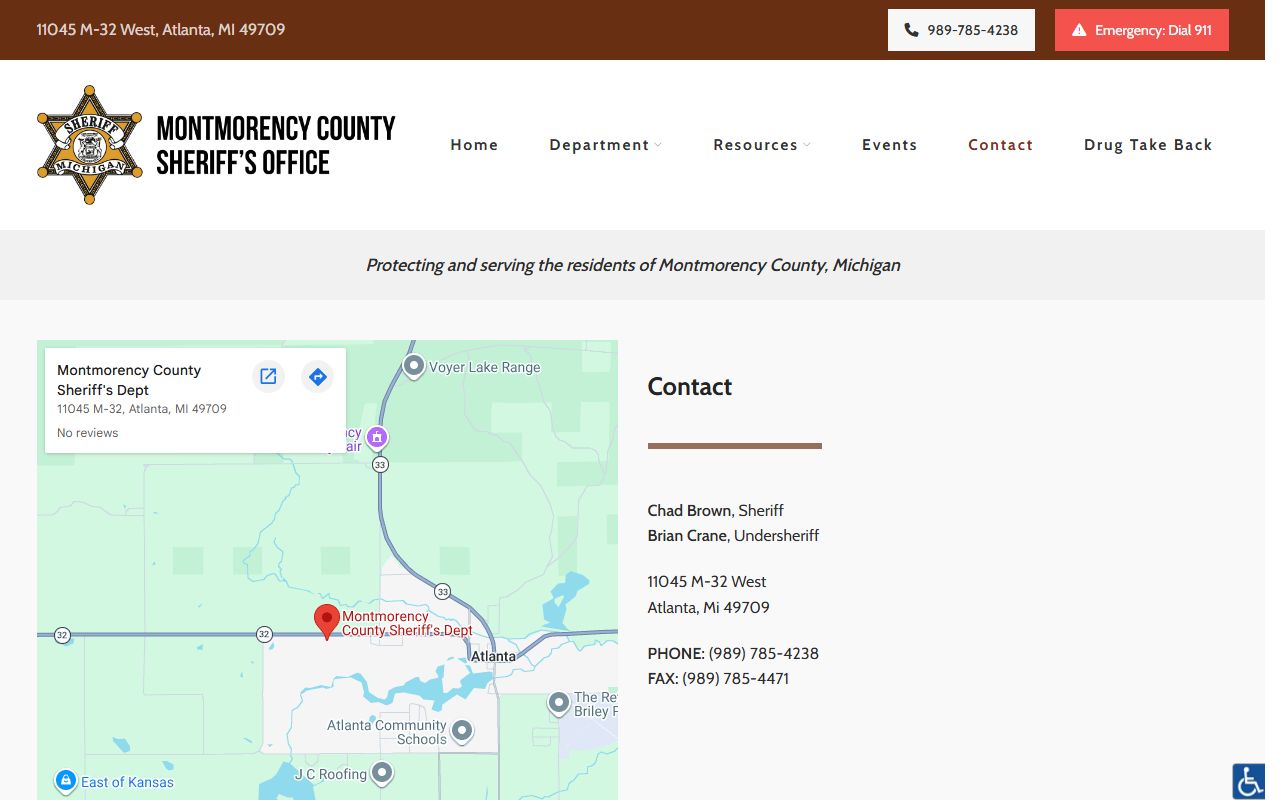
Sheriff staff can confirm the arresting agency, the lodging destination, and whether an arrest report is available. State systems then pick up the record only after a case reaches conviction or state supervision.
Montmorency County Charges Versus Convictions
Being charged is not the same as being convicted. A charge is an accusation. A conviction is the outcome after a plea or a trial. Many charges never become convictions, because they are dismissed, reduced, or withdrawn. The comparison below shows why the two must be read as separate stages of a case.
| Charge | Conviction | |
|---|---|---|
| Stage | Accusation at filing | Verdict or guilty plea |
| Burden of Proof | Probable cause | Beyond a reasonable doubt |
| Who Decides | The prosecutor | The judge or jury |
| Public Record | Yes, in the case file | Yes, plus criminal history |
A charge that shows in the court file does not prove guilt. Reading a Montmorency County arrest and charge record fairly means checking the disposition, not just the charge line. The final plea, verdict, or dismissal is the part that shows how the case actually ended.
Montmorency County Arrest Reports From the Sheriff
The court file holds the charges. The arrest report itself is a law-enforcement record held by the sheriff. To obtain a sheriff arrest or incident report, use the Montmorency County Freedom of Information Act process. Under Michigan FOIA, MCL 15.233 gives the public the right to inspect and copy records held by a public body, subject to exemptions. The county must respond within five business days unless the requester agrees to more time.
A request should describe the record clearly enough for county staff to find it. Not every part of an arrest report is releasable, because active investigations and protected information can be withheld. The booking and custody record is separate again, held by the jail that lodges the person.
These are the main channels for the arrest side of a Montmorency County record.
- Montmorency County FOIA request for a sheriff arrest or incident report.
- Sheriff non-emergency line at 989-785-4238 to confirm the arresting agency.
- Jail and Corrections line at 989-785-2582 for custody routing.
- Alpena County Correctional Facility for the booking record after lodging.
Restricted Montmorency County Charge Records
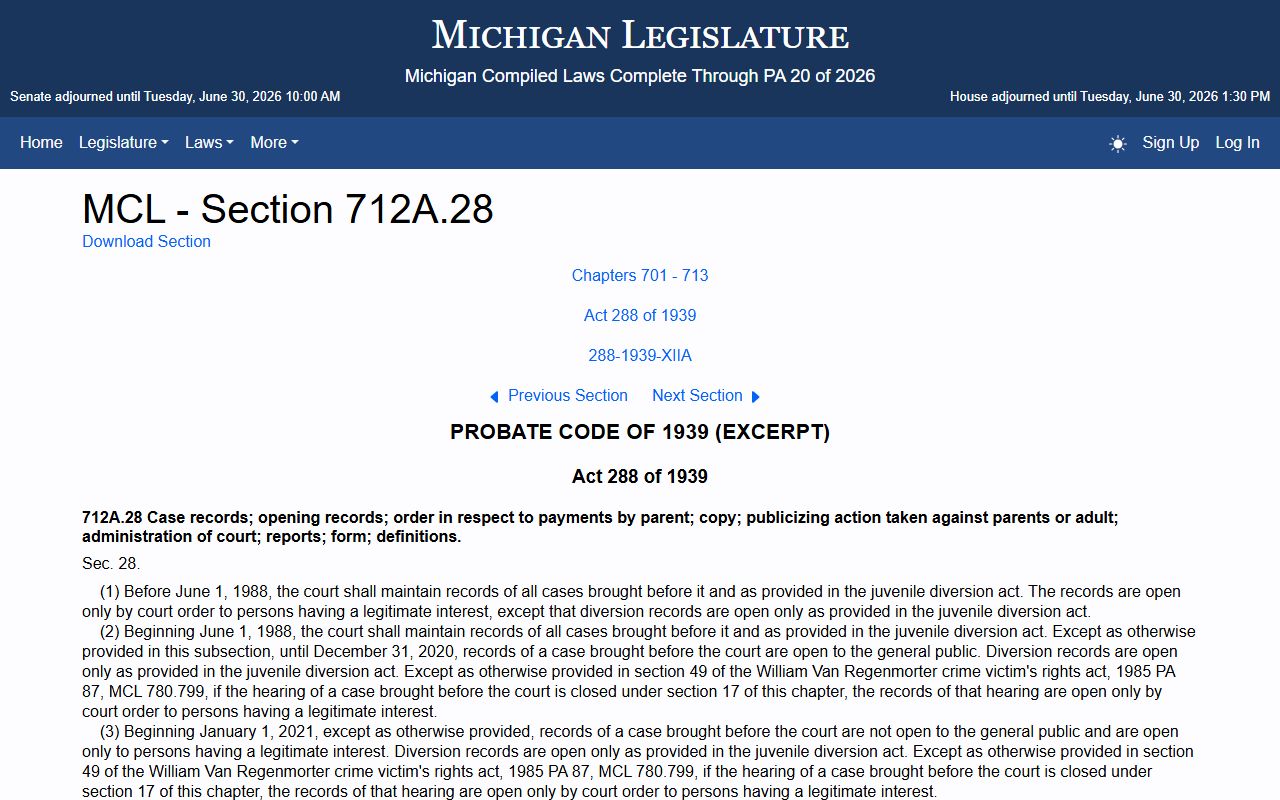
Not every charge record is open to the public. Juvenile cases are the clearest example. Under MCL 712A.28, juvenile court records are kept by the court and are open only by court order as provided by law. Charges against a minor generally will not appear in the public case search. Nonpublic and suppressed cases are also excluded from the MiCOURT results, so a sealed or protected matter simply will not show.
The Michigan juvenile record statute sets the rule that keeps those charges out of ordinary public view.
Some adult charges can also be restricted later. A person may apply to set aside an eligible conviction under MCL 780.621, filed in the court where the conviction happened. When a set-aside is granted, public court and criminal-history display changes, though the record is not erased for every government purpose. Dismissed charges, ongoing investigations, and protected personal identifiers may also be withheld or redacted.
Important: This site is not a consumer reporting agency under the Fair Credit Reporting Act, and these records may not be used to decide credit, employment, housing, or insurance.