
What Is a Montmorency County Court Docket
A docket is a case diary. Every court keeps one for every case it opens. Each line marks a single event and the date it happened. In Montmorency County trial courts, the official name for this list is the register of actions. It runs from the first filing to the final order. Read top to bottom, it tells the whole story of a case without the paperwork attached.
The Montmorency Courts case search names exactly what the public docket holds. You can view the register of actions, hearing dates, the names of the parties, the names of counsel, the case status, and the financial history. That is the skeleton of the file. It shows what was filed and when, but not the filed papers themselves. The docket is a map. The full case file is the territory.
- Register of actions
- The dated list of filings, hearings, notices, orders, and payments in a case.
- Hearing date
- The day, and often the time and courtroom, set for a case event before a judge or magistrate.
- Case status
- The court's label for the stage of a case, such as open, disposed, or transferred.
- Financial history
- The running record of fines, costs, bonds, restitution, payments, and balances owed.
How to Pull a Montmorency County Docket
Montmorency County docket lookups start at the Montmorency Courts case search page. That page links the state MiCOURT portal and gives the county-specific paths. Pick the court that fits your case type first. A traffic ticket lives in the District Court. A divorce lives in the Circuit Court. An estate lives in the Probate Court. Choosing the wrong court is the most common reason a search comes up empty.
- Open the Montmorency Courts case search page. It lists the correct links for each local court and is the safest place to begin.
- Pick the right court. Use the 88-2 District Court path for traffic, misdemeanors, and small claims, the 26th Circuit, Family, Juvenile, and FOC path for felonies and divorce, or the Montmorency Probate Court path for estates and guardianships.
- Enter a party name or a case number. The public search returns matching cases; a secured search by date of birth is open only to users approved by the State Court Administrative Office.
- Clear the hCaptcha challenge when the portal prompts you. It is not skipped, and it guards the public case search.
- Open the case and read the register of actions. Scan the hearing dates, the case status, and the financial history to see where the matter stands.
The portal runs on JavaScript, so follow the on-screen prompts after you select a court. Results load in the browser. Note: the public case search shows docket entries and case status, but it does not hand back copies of the actual filed documents.
What a Montmorency County Docket Shows
The public Montmorency County docket is built from a fixed set of fields. Montmorency Courts spells out what the search returns, and Michigan trial court practice fills in the detail. Each field answers a different question about the case. Together they let you track a matter without ever touching the paper file. The table below inventories the entries a Montmorency County register of actions can carry.
| Field | What It Shows |
|---|---|
| Case number | The court-specific ID, tied to a court code such as D88~2, C26~2, or P60. |
| Court and division | District, Circuit, Family, Juvenile, Friend of the Court, or Probate. |
| Parties | Plaintiff and defendant, People of Michigan and defendant, or petitioner and respondent. |
| Counsel | The attorney of record for a party, where the record is public. |
| Register of actions | The dated list of filings, motions, notices, orders, judgments, and payments. |
| Hearing dates | The date, time, court, and sometimes the judge or courtroom for a case event. |
| Case status | Pending, disposed, transferred, bound over, dismissed, or default. |
| Financial history | Fines, costs, assessments, restitution, bonds, payments, and balances. |
Criminal dockets add charge detail, such as the offense, the statute, the plea, and the sentence. Traffic dockets add the citation number, the responsibility finding, and any default judgment fee. Probate dockets add fiduciary appointments, inventory events, and letters of authority. The mix of entries depends on the kind of case, but the core fields stay the same across all three courts.
Courts That Publish Montmorency County Dockets
Three courts feed the public docket in Montmorency County. Each handles a different slice of the caseload, and each has its own MiCOURT path. The 26th Circuit Court is the primary trial court, shared with Alpena County under the 26th Judicial Circuit. The 88-2 District Court is the court most residents meet first. The Probate Court sits apart from both. The 26th Circuit Court page for Montmorency lays out the circuit court launch context and contact details.
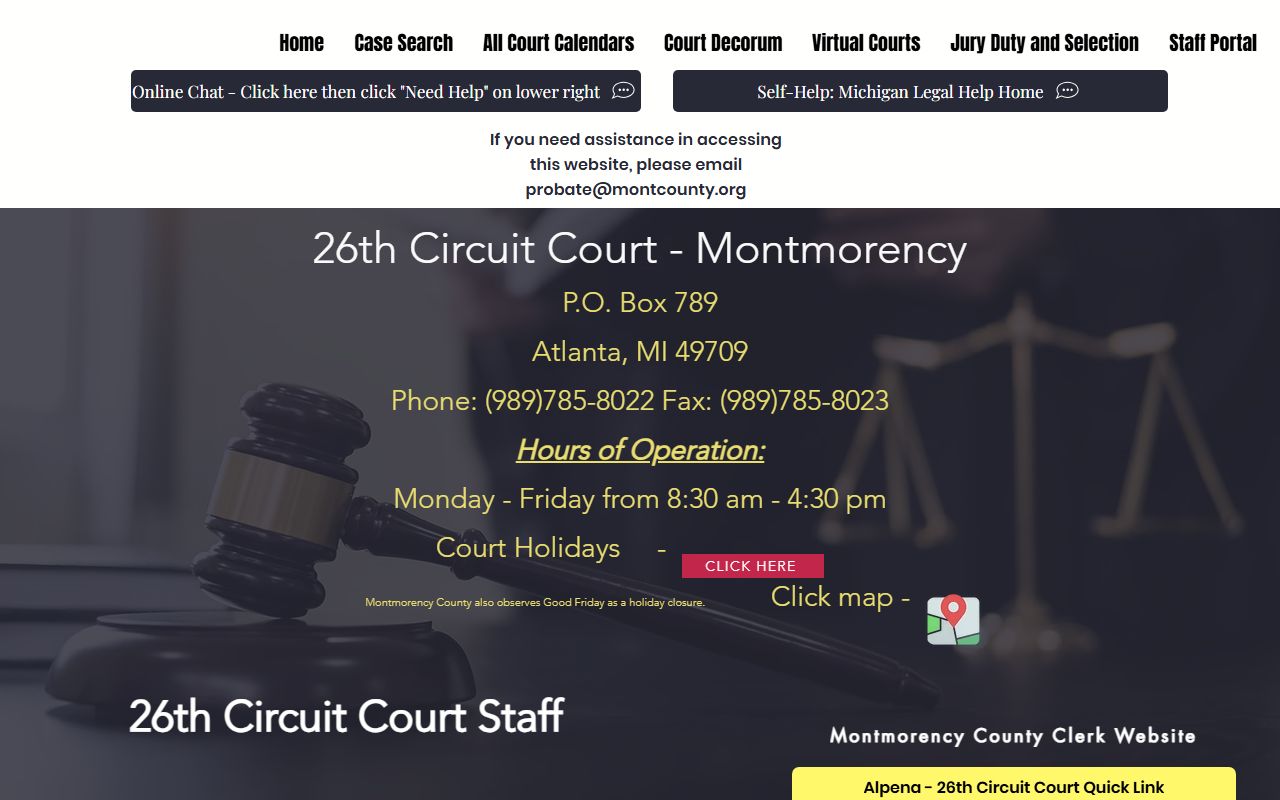
That page routes you into the shared circuit docket for higher-value civil, felony, and family cases. The list below shows which court publishes which dockets.
- 26th Circuit Court, Family, Juvenile, and Friend of the Court: felonies after bindover, civil over $25,000, divorce, custody, support, PPOs where public, and District Court appeals.
- 88-2 District Court: traffic civil infractions, misdemeanors up to one year, felony arraignments and preliminary exams, small claims, landlord-tenant, and general civil up to $25,000.
- Montmorency Probate Court: estates, wills, trusts, guardianships, conservatorships, developmentally disabled adult matters, and mental health cases where public.
The District Court page states that, unless a case is suppressed by order or made nonpublic by statute, district court information is public knowledge. That rule of thumb holds across all three courts.
Montmorency County Docket vs Full Case File
A Montmorency County docket and a case file are not the same thing. The docket is the index. The case file is the stack of documents behind it. The public search gives you the index for free, but the documents are a separate request. Montmorency Courts is direct about this. The case search does not provide copies of documents, and users who need copies must contact the court.
| Docket | Full Case File | |
|---|---|---|
| Format | Dated list of entries | Motions, orders, and other papers |
| Access | Free online through MiCOURT | Request from the court or clerk |
| Contents | Events, dates, status, balances | The filed and signed documents |
| Use | Track hearings and progress | Read the actual pleadings and rulings |
To get documents, go to the court that holds the file. For Circuit Court copies, call the County Clerk and Clerk of the 26th Circuit Court at 989-785-8022. For District Court traffic, criminal, and civil matters, call the 88-2 District Court at 989-785-8035. For Probate Court records, call probate staff at 989-785-8067 or email probate@montcounty.org. Do not expect downloadable pleadings, judgments, or transcripts from the public docket route.
Montmorency County Docket Scheduling and Motion Days
Hearing dates on the docket are not random. Circuit Court motions in Montmorency County follow a set rhythm. Motion days for domestic, criminal, and civil matters are generally held twice each month on Mondays. Scheduling runs through the Alpena Circuit Court office, since the 26th Judicial Circuit is shared between the two counties. The 26th Judicial Circuit Court page lays out the scheduling process, filing instructions, and court holidays for both counties.
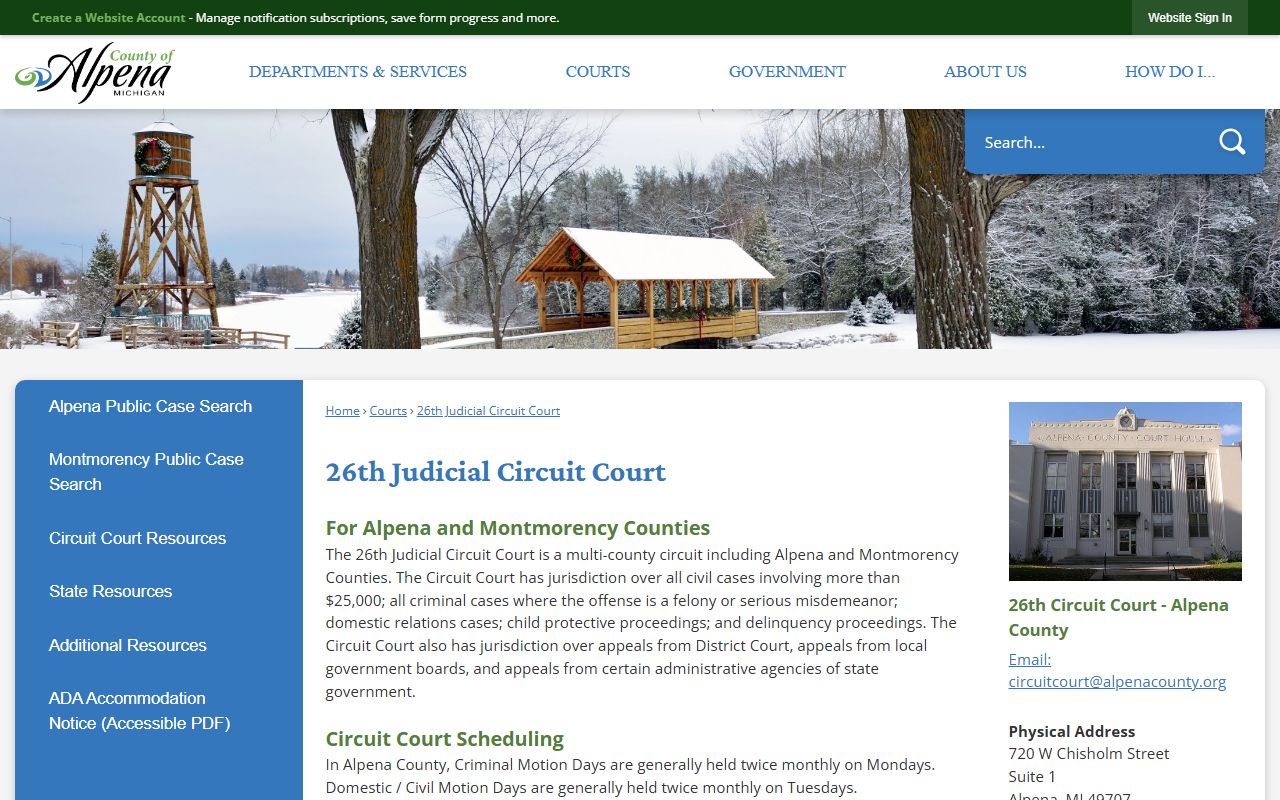
That page is where attorneys and parties confirm circuit hearing dates that later show up on the docket. To set or check a circuit motion date, call the Alpena Circuit Court at 989-354-9573. Judge's copies of filings go to the Alpena office at 720 W. Chisholm Street, Suite 1, while original filings go to the Montmorency County Clerk in Atlanta.
The circuit observes standard court holidays plus Good Friday, so a Monday holiday can shift a motion day. Note: hearing dates can move, so confirm a scheduled circuit date with the court before you rely on the docket entry.
How to Read Case Status and Financial History
Two Montmorency County docket fields carry most of the weight. Case status tells you the stage. Financial history tells you the money. Read together, they answer the questions most people bring to a docket search. Is the case still open? Did it go to judgment? Is a balance still owed?
Case status uses short court labels. A pending or open case is still moving. A disposed or closed case has reached a final outcome. Bound over means a felony passed preliminary exam and moved from District Court to Circuit Court. Transferred, dismissed, and default are other common status terms. A status of suppressed or nonpublic means the case is shielded and will not show full data.
Financial history reads like a ledger. It can list fines, costs, assessments, restitution, and bond amounts, along with payments made and balances due. Traffic cases may show a default judgment fee added after a missed deadline. The 88-2 District Court adds a 3% fee for credit card payments. A balance on the docket is a live debt, not old history, so verify the current amount with the court before you pay.
Why a Montmorency County Case May Not Appear
Not every case shows up in a public search. The Montmorency County case search leaves out nonpublic and suppressed cases by design. Michigan court rules and statutes shield whole categories of records. A blank result does not always mean the case does not exist. Sometimes it means the law keeps that case off the public docket.
Juvenile delinquency and child protective files are heavily restricted and open only by court order. Adoption records, mental health hospitalization matters, and sealed or set-aside convictions are also kept nonpublic. PPO files may show limited data while protected addresses stay private. Personal identifiers, such as Social Security numbers and financial account numbers, are redacted even on public cases.
One statewide tool has its own gap. The Michigan Courts ePAY ticket search lets people find and pay tickets online, but its court list does not include Montmorency.
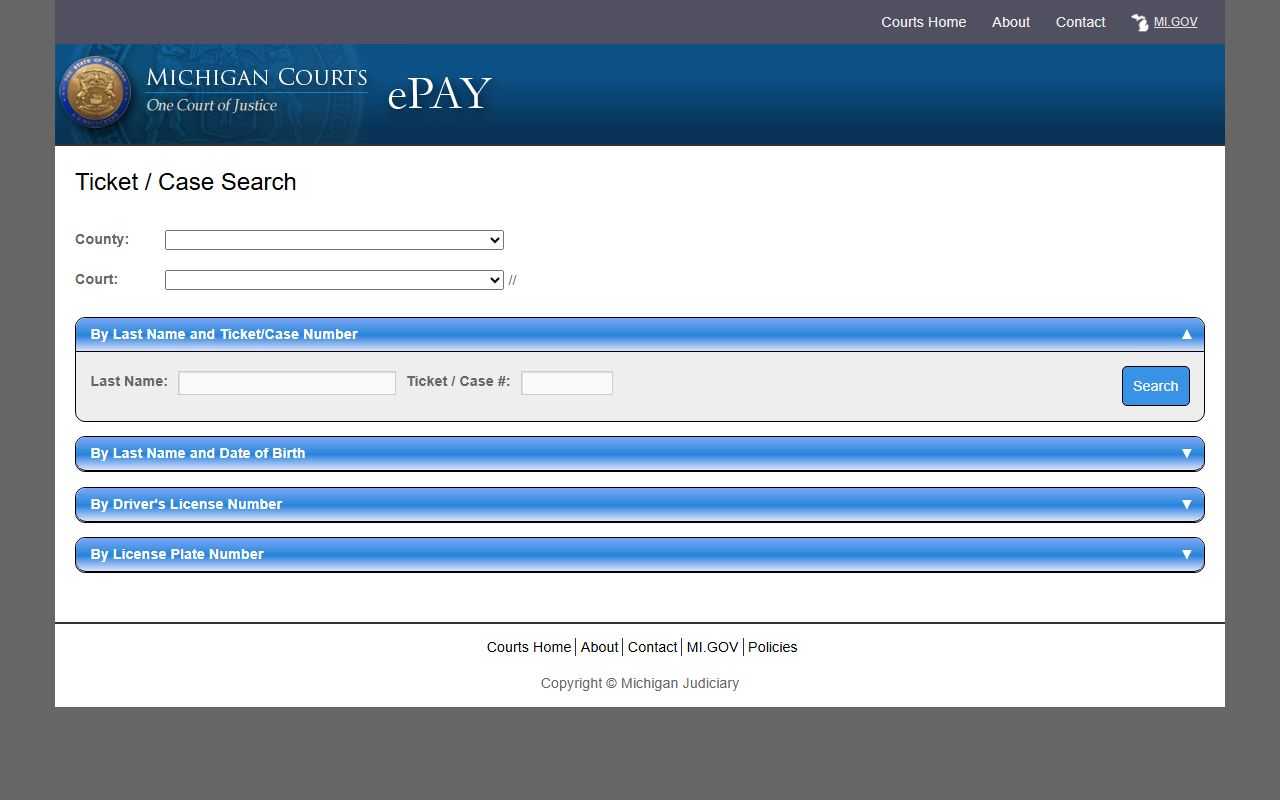
Because Montmorency tickets are not in that search, use the 88-2 District Court directly for ticket and payment questions rather than the statewide ePAY tool.
Other Ways to Get Docket Records
The online Montmorency County docket is the fastest channel, but it is not the only one. When a case is not online, when you need a document, or when a search will not load, the courts answer by phone and in person. Each Montmorency court runs its own counter during business hours, Monday through Friday, 8:30 a.m. to 4:30 p.m.
The list below shows the direct lines for docket questions and document copies.
- 88-2 District Court: 989-785-8035 for traffic, misdemeanor, small claims, and general civil dockets.
- County Clerk and Clerk of the 26th Circuit Court: 989-785-8022 for circuit civil, felony, and family docket copies.
- Montmorency Probate Court: 989-785-8067, or probate@montcounty.org, for estate and guardianship dockets.
Original circuit filings go by mail to the Montmorency County Clerk at P.O. Box 789, Atlanta, MI 49709, or by courier to 12265 M-32. The Probate Court accepts temporary e-filing by email or fax while the statewide MiFILE system rolls out. For county records outside the court file, such as sheriff reports, the Montmorency County FOIA process is the right path. For sealed court files, though, FOIA is not a workaround, and the court rules control access.