
Criminal Court Records in Montmorency County
A criminal court record in Montmorency County is the case file a court opens the moment charges are filed. The clerk builds and holds that file for the life of the case. It starts with the charging document and grows with every filing, order, and hearing. Felony files are kept by the Montmorency County Clerk, who also serves as Clerk of the 26th Circuit Court. Misdemeanor and traffic-based criminal files sit with the 88-2 District Court. Every event is logged on a register of actions, the running list of what the court has done. These criminal files sit alongside the county's wider court records.
Adult criminal cases in Montmorency County begin in the 88-2 District Court. That court tells the defendant the charge, explains the rights at stake, and sets bond. It handles misdemeanor trials and sentencing when the offense carries no more than one year in jail. Felony charges also start there, at arraignment and preliminary examination. When a judge finds probable cause, the felony binds over to the 26th Circuit Court for trial and sentencing. The circuit is shared with Alpena County. So one case can leave a record in two courts as it moves up.
The 88-2 District Court Criminal Division page explains how adult criminal cases open, from arraignment through felony bindover.
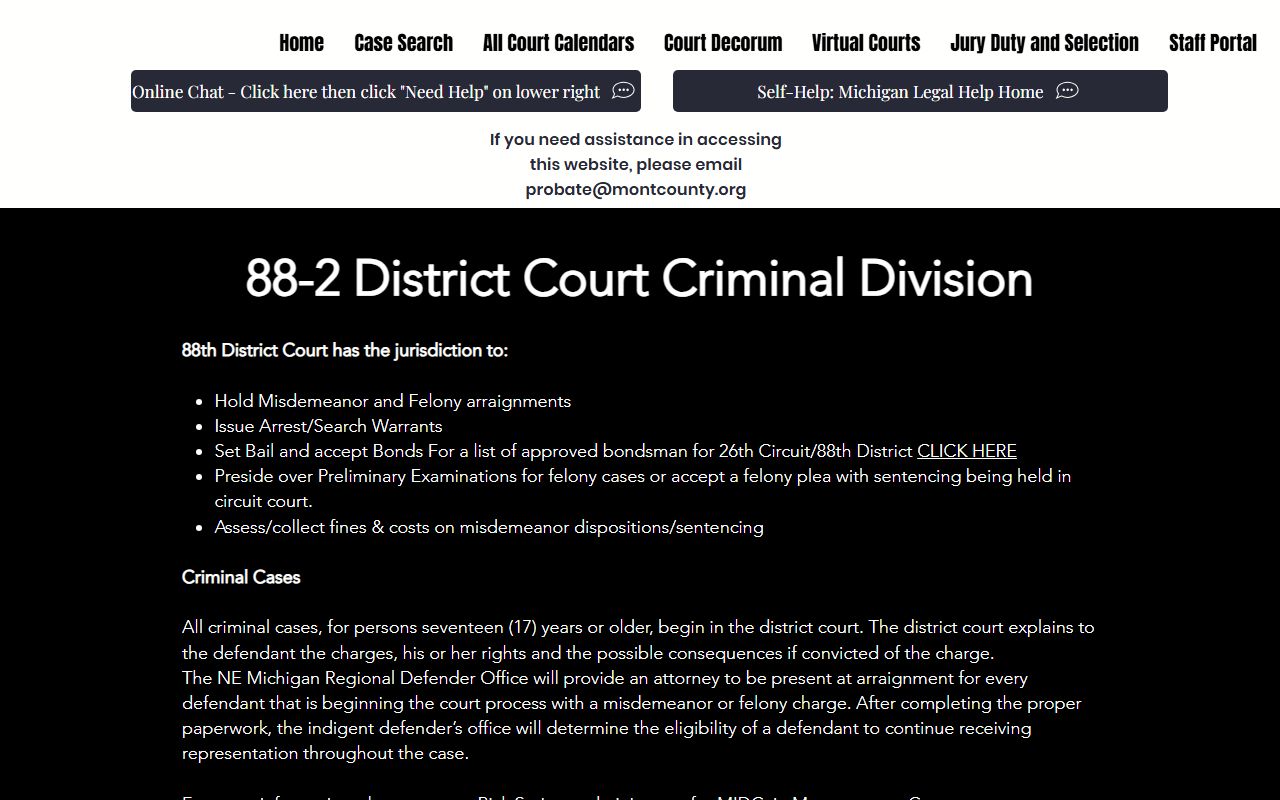
That first appearance sets the charge, the rights, and the bond that anchor the rest of the criminal court record.
How to Search Montmorency County Criminal Records
Montmorency County criminal court records are searched online through the state MiCOURT public case search. The county case-search page links each local court directly. Public results show the register of actions, hearing dates, party names, counsel, case status, and financial history. The search does not include nonpublic or suppressed cases, and it does not hand over document copies. For copies, a records seeker contacts the court that holds the file.
- Open the Montmorency Courts case-search page and pick the right court link.
- For misdemeanors and traffic-based crimes, use the 88-2 District Court; for felonies after bindover, use the 26th Circuit Court.
- Search by defendant name or case number, then clear the hCaptcha prompt when it appears.
- Open the case to read the register of actions, plea, disposition, and sentence.
- Ask the clerk for a certified copy when a document is needed, since the portal shows no images.
State-level criminal history runs on a separate track. The Michigan State Police keep the statewide rap sheet, searched through ICHAT. For anyone sent to state prison, parole, or probation, the MDOC OTIS offender search shows custody and supervision status. County court files, the state history, and the corrections record are three different sources.
Stages of a Montmorency County Criminal Case
A Montmorency County criminal case moves through set stages, and the record grows at each one. The charge is filed. The defendant is arraigned. The case is screened at pretrial, and a felony gets a preliminary examination. The matter then ends in a plea or a trial, followed by disposition and sentence.
Case flow: Charges Filed › Arraignment › Pretrial / Preliminary Exam › Plea or Trial › Disposition › Sentencing
Arraignment is the first court appearance. The judge or magistrate reads the charge, notes the plea, and addresses bond. Pretrial and motions come next, where lawyers argue evidence, discovery, and possible dismissal. In felony cases, the preliminary examination tests whether probable cause supports a bindover to circuit court. Most cases end with a plea. When they do not, a bench or jury trial decides guilt. Disposition records the outcome of each charge, and sentencing sets the penalty.
Note: A felony can appear in both the district and circuit court records, since the case opens in one court and finishes in the other.
What a Montmorency County Criminal Record Shows
A Montmorency County criminal court record is organized into fields. Each one answers a different question about the case. The public case search surfaces most of these, while sealed detail stays hidden. Reading the file means knowing what each field carries.
| Field | What It Shows |
|---|---|
| Case Number | Court-specific identifier; district files carry a D88~2 code, circuit files a C26~2 code. |
| Parties | Listed as the People of the State of Michigan versus the named defendant. |
| Charges | Offense description, the statute cited, and whether it is a misdemeanor or felony. |
| Counsel | The attorney of record, including an appointed defender where one is named. |
| Plea | The defendant's answer to each charge, such as guilty, not guilty, or no contest. |
| Register of Actions | The dated log of filings, hearings, motions, orders, and payments. |
| Disposition | The final result of each charge, from dismissal to conviction. |
| Sentence | The penalty imposed, such as jail, probation, fines, costs, or restitution. |
| Financial History | Fines, costs, restitution, bond, payments, and balances owed. |
Reading Dispositions and Sentences
Disposition is the heart of a Montmorency County criminal court record. It tells whether a charge stuck, changed, or fell away. A sentence follows only a conviction. Reading both correctly means knowing the common terms.
- Guilty plea
- The defendant admits the charge and accepts the penalty.
- No contest (nolo)
- The defendant does not fight the charge but does not admit guilt; the court still treats it as a conviction for sentencing.
- Dismissed
- The charge is dropped by the court or the prosecutor and carries no penalty.
- Acquittal
- A judge or jury finds the defendant not guilty after trial.
- Disposition
- The final outcome recorded for each charge.
- Sentence
- The penalty set after a conviction, such as jail, probation, fines, or restitution.
A record can show several charges with different outcomes. One count may end in a plea while another is dismissed.
Charges vs. Convictions
Being charged is not the same as being convicted. A Montmorency County criminal court record can list charges that were later dropped, dismissed, or ended in acquittal. Reading the file means telling an accusation apart from a proven result. For a closer look at how charges get filed after an arrest, the county keeps separate arrest records and court charges.
| Charge | Conviction | |
|---|---|---|
| Stage | Accusation | Verdict or plea |
| Burden of Proof | Probable cause | Beyond a reasonable doubt |
| Who Decides | Prosecutor files it | Judge or jury confirms it |
| Public Record | Yes | Yes |
| Meaning | The case is pending | The case is proven |
A charge shows what the state alleged. A conviction shows what the court found. The two should never be read as one.
Prosecutor and Defender Roles
Two offices shape most Montmorency County criminal cases. The prosecutor decides what charges to file and pursues them in court. The defender represents people who cannot afford a lawyer. Both leave their marks on the record, from the charging decision to the plea.
Prosecutor Vicki P. Kundinger leads the Montmorency County Prosecutor Office, with Assistant Prosecutor Luke Kwiatkowski. The office reviews police reports, decides whether to file formal charges, and represents the People at hearings and trial. In a formal traffic hearing, the prosecutor stands in for the officer. When a felony clears preliminary examination, the office carries the case into circuit court.
The Montmorency County Prosecutor page lists the office staff and the victim advocate who supports people through a case.

The charging decision made in that office is the first entry that shapes a criminal court record.
On the defense side, the Northeast Michigan Regional Defender Office provides appointed counsel. An attorney is present at arraignment for every defendant starting on a misdemeanor or felony charge. The office then checks whether a person qualifies for continued representation.
NE Michigan Regional Defender Office
615 W. Chisholm St.
Alpena, MI 49707
989-340-1100
Fines, Bonds, and Show-Cause Hearings
Money runs through a Montmorency County criminal court record from the first appearance to the last payment. The 88-2 District Court sets bail, accepts bonds, and applies posted bond money toward fines and costs at sentencing. Missed payments can trigger a show-cause hearing. Each of these events is logged in the file's financial history.
- Bail and bond: set by the district court or magistrate to secure the defendant's return; a posted bond may later cover fines and costs.
- Fines and costs: ordered at sentencing and tracked as a running balance.
- Restitution: repayment ordered to compensate a victim.
- Show-cause hearing: a court date requiring a defendant to explain unpaid fines or costs.
- Bench warrant: issued when a defendant misses court or fails to comply.
A balance that reaches show cause can lead to a bench warrant, which the court tracks as a separate event in the file.
Nonpublic Montmorency County Criminal Records
Michigan does not erase Montmorency County criminal records the way the word expunge suggests. The state uses the term set aside. A set-aside limits public access to an eligible conviction, but it does not destroy the file for every government purpose. A separate track covers records that are sealed or nonpublic by rule.
| Sealed | Set-Aside | |
|---|---|---|
| Visibility | Hidden from public view | Removed from public criminal history |
| What It Covers | Nonpublic cases and protected files | An eligible conviction after relief is granted |
| Law Enforcement | Limited access remains | Some agencies keep access |
| Eligibility | Set by court rule or statute | MCL 780.621 sets who qualifies and when |
| How It Starts | By court order or statute | By application in the court of conviction |
Michigan's adult conviction set-aside statute, MCL 780.621, governs which convictions can be cleared and how.
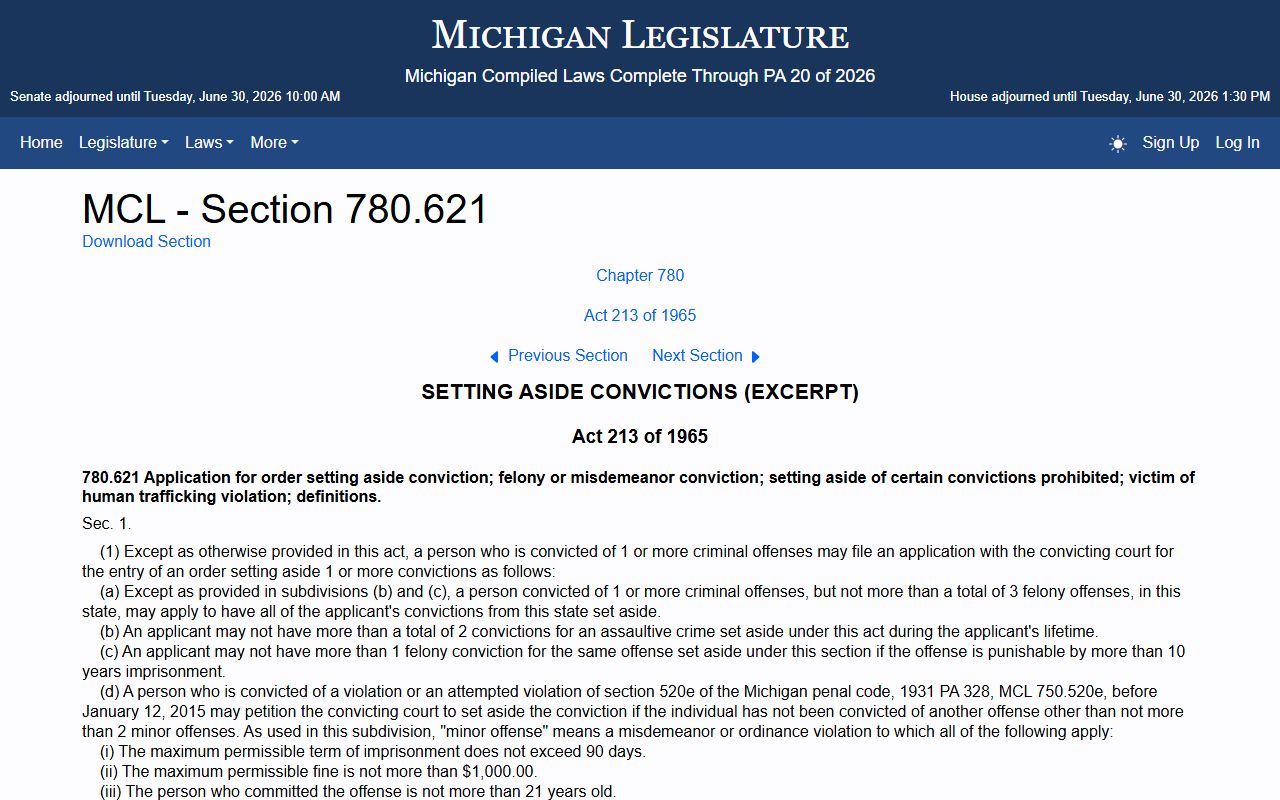
A person files the state form MC 227 in the court where the conviction happened, using a separate application for each court. Montmorency convictions route to the 88-2 District Court for eligible misdemeanors or to the 26th Circuit Court for eligible felonies. Waiting periods depend on the number and type of prior convictions.
The set-aside waiting-period statute, MCL 780.621d, spells out those timelines for people with multiple felony convictions.
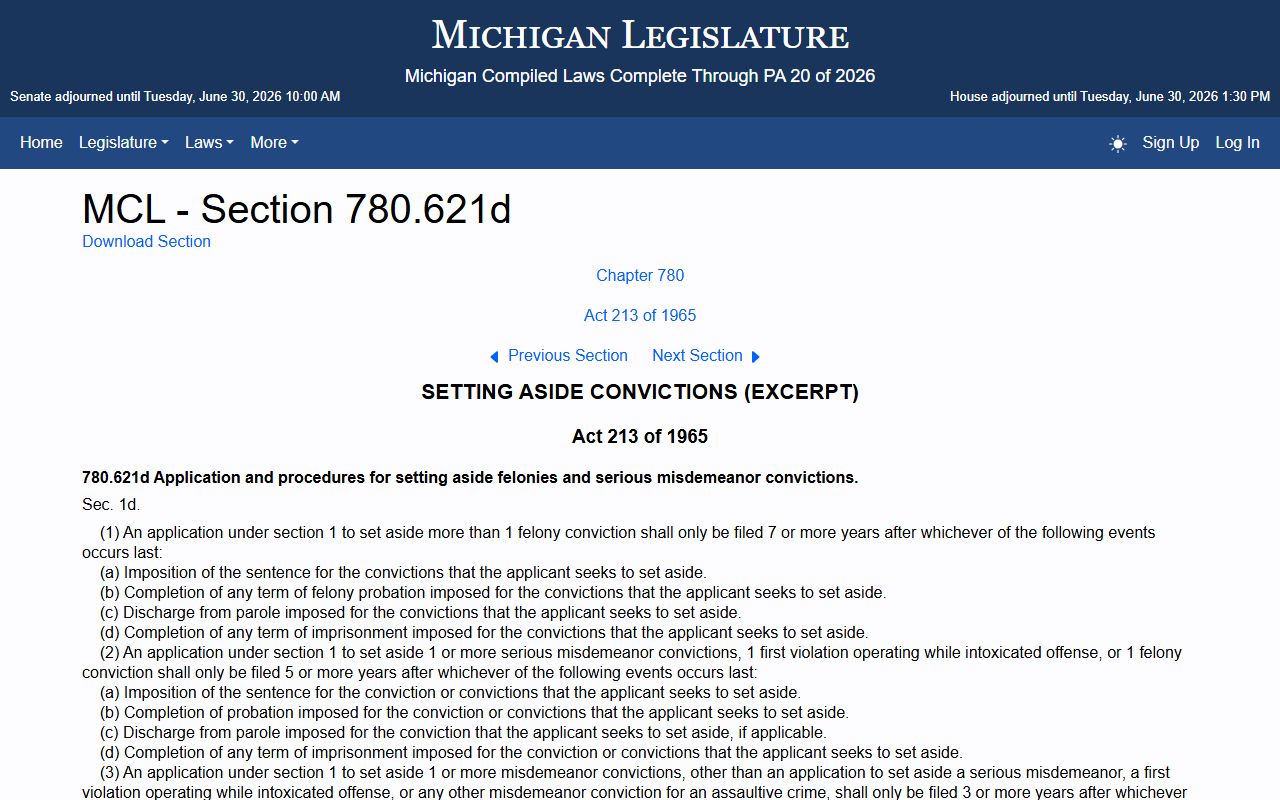
Once a court grants a set-aside, the change reaches the state systems too, and MDOC OTIS may remove the offender's display.
Important: A set-aside changes public access, but it does not promise that every dismissal, acquittal, or old conviction can be cleared for all purposes.
Note: Setting aside a traffic offense under MCL 780.621c does not by itself remove it from Michigan Secretary of State driving records.
Public Access to Montmorency County Criminal Records
Michigan court records are public by default. Court files are governed by the Michigan Court Rules, and county public records fall under the state Freedom of Information Act. Criminal case files stay open unless a statute or court order makes them nonpublic. The rules that control access are worth knowing.
Key Statutes:
MCR 8.119 - Governs court records, clerk duties, and public access, including limits on posting document images online.
MCL 15.233 - Gives the public the right to inspect and copy records held by public bodies under the state FOIA.
MCL 712A.28 - Keeps juvenile court records closed except by court order as provided by law.
Court case files and county FOIA are two different doors. The court and clerk control the case file under the court rules and the local MiCOURT search. FOIA reaches county public-body records, such as many sheriff and administrative files, but it does not open sealed court records, juvenile files, or mental health matters.
Restricted Montmorency County Criminal Records
Some Montmorency County criminal records never reach public search. Juvenile delinquency files are closed except by court order. Sealed and set-aside cases drop out of public view. Charges still under investigation, and warrants not yet served, may stay hidden until a case becomes public. The court also redacts protected identifiers before a file is shown.
Redactions cover Social Security numbers, financial account numbers, and protected information about minors. The public file shows the case, not every private detail inside it.
Note: A case missing from public search is not proof that no record exists, since the file may be sealed, nonpublic, or still moving between courts.