
What Probate Covers in Montmorency County
The Montmorency Probate Court holds broad authority over property and protective matters. It probates wills and supervises the administration of estates and trusts. It appoints and oversees guardians and conservators for both adults and minors. It also hears proceedings involving developmentally disabled adults and matters of hospitalization or treatment for people who are mentally ill. In plain terms, probate deals with what a person leaves behind and with people who need legal protection right now.
One court hears all of these cases in the county. The Montmorency Probate Court sits in the county seat of Atlanta and works next to the district and circuit courts. Judge Lora E. Greene presides. The court warns that its public information covers highlights only. It is not a full statement of the law, and its clerks are not attorneys, so they cannot give legal advice. For legal questions, staff point families to state-approved form packets or to Michigan Legal Help.
The court publishes staff, jurisdiction, and service details on its official Montmorency Probate Court page.
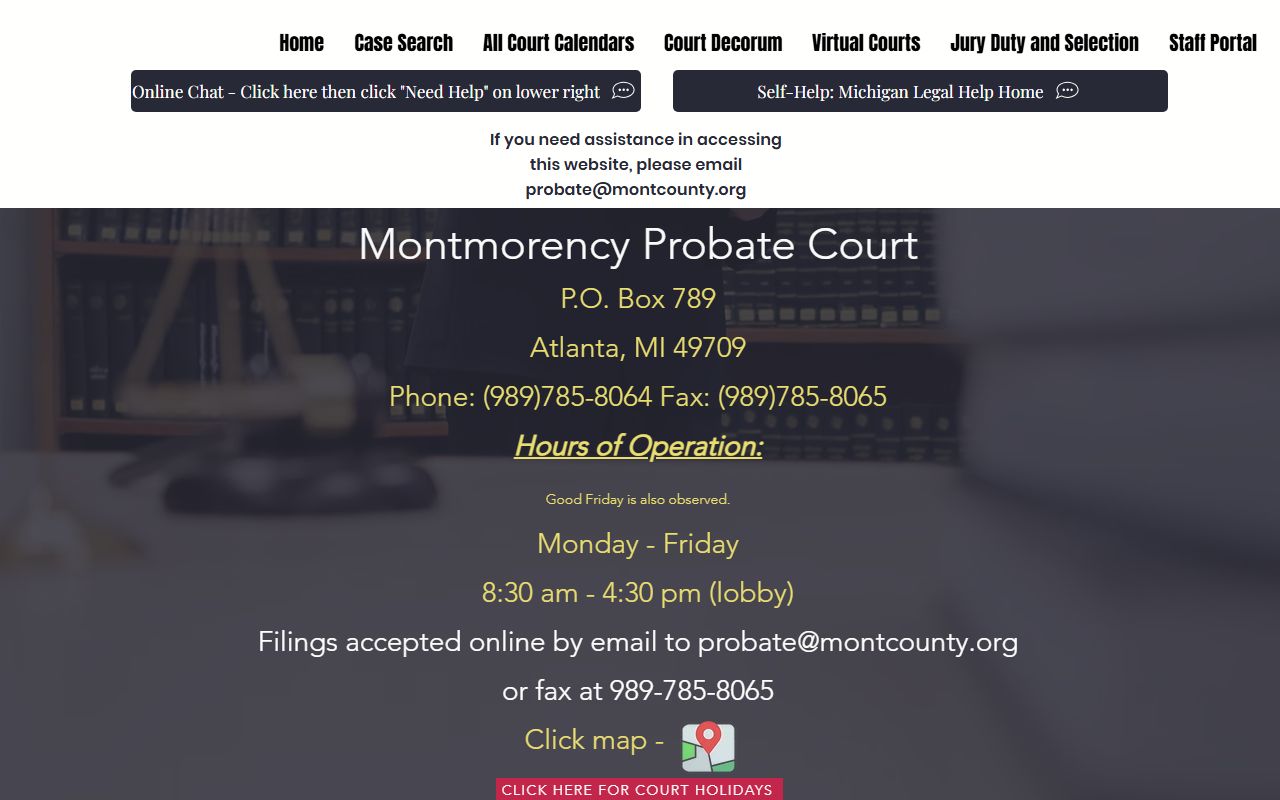
That page lists the judge, the court administrator, and the deputy registers who process filings. It also links the quick tools most families need, from approved forms to the payment portal.
Montmorency County Probate Court Office
All probate filings and questions go through a single office in Atlanta. Court Administrator, Register, and Official Court Reporter Jodi Gordon runs the office and sees visitors by appointment. Deputy Probate Registers Nicole Morisett and Kenneth Radzibon handle day-to-day case processing. The office can also share a list of court-appointed guardians, conservators, and non-attorney guardians ad litem when you ask.
Montmorency Probate Court
12265 M-32 West, P.O. Box 789
Atlanta, MI 49709
989-785-8067
Fax 989-785-8065
probate@montcounty.org
Call the office first when you need copies, a case status, or a form packet. The public case-search tool does not provide document images, so direct contact is the way to reach the actual file.
Probate Terms in Montmorency County
Probate paperwork leans on a handful of legal words. Learn these first, and the forms and case registers read much more clearly. Each term below shows up often in Montmorency County probate records.
- Testator
- The person who made the will. A will speaks for the testator after death.
- Executor
- The person named in a will to carry out its terms. Michigan courts often call this role the personal representative.
- Intestate
- Dying without a valid will. State law then decides who inherits.
- Guardianship
- A court order that lets one person make personal and care decisions for a minor or an adult who cannot decide alone.
- Conservatorship
- A court order that puts one person in charge of another person's money and property.
- Fiduciary
- Anyone the court trusts to act for someone else, such as an executor, guardian, conservator, or trustee. A fiduciary must act in good faith.
Search Montmorency County Probate Records
Public probate cases appear in MiCOURT, the statewide case-search system. Montmorency Probate Court uses the court code P60. Open the direct MiCOURT probate search and you can look up a register of actions, hearing dates, parties, counsel, case status, and financial history. You will not see scanned wills, orders, or inventories there. Document copies come from the court office, not the online tool.
The search itself is simple once you pick the right court. The table below shows the fields you meet on the way in.
| Field | Type | Required | Notes |
|---|---|---|---|
| Court path | Court selector | Yes | Use P60 for Montmorency Probate Court |
| Party, decedent, or ward name | Text | Varies | Prompted after you select the court |
| Case number | Text | Optional | Fastest route when you know it |
| Case type | Filter | Varies | Estate, trust, guardianship, or conservatorship |
| Secured search | Login | Optional | Restricted features need an authorized login |
| hCaptcha | Challenge | As prompted | Confirms you are not a bot |
Note: Mental health cases and parts of some guardianship and conservatorship files stay off the public search under court rules.
File Probate Cases in Montmorency County
Montmorency Probate Court runs a temporary electronic filing process while the state finishes its MiFILE rollout from the Michigan Supreme Court. You do not visit a portal to upload documents. Instead, you send them straight to the office, then pay online. The steps stay short and predictable.
- Pick your case type, such as an estate, a trust, an adult or minor guardianship, or a conservatorship.
- Prepare court-approved forms or a probate packet for that case type.
- Email your documents to probate@montcounty.org or fax them to 989-785-8065.
- Do not mail paper copies unless court staff ask you to.
- Pay your filing fees through the court's online payment link.
- Wait for the court to confirm it received your filing by email or fax.
The court explains this workflow on its probate e-file page.
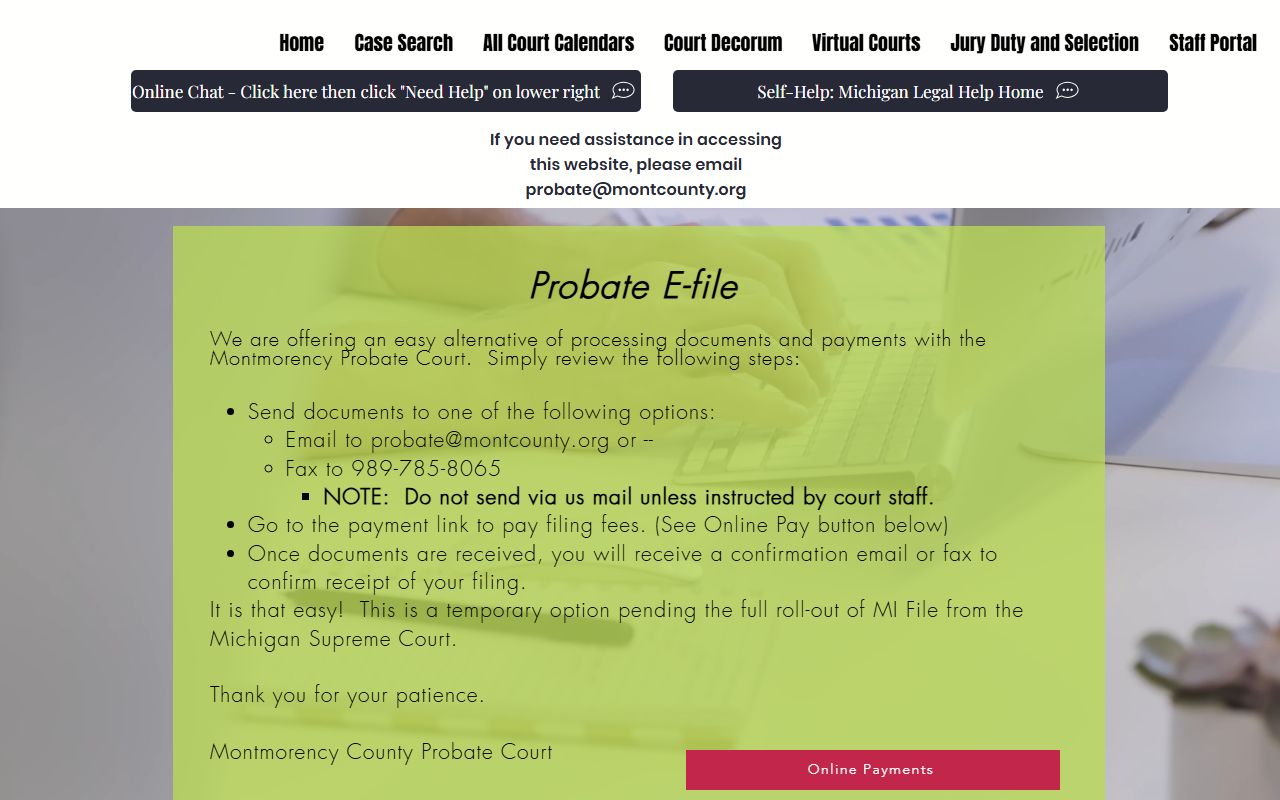
That page repeats the email and fax details and reminds filers to skip U.S. mail unless instructed. Keep your confirmation message, since it proves the court has your documents.
Forms and Training for Montmorency County Probate
Most probate trouble starts with the wrong form. The court tries to prevent that by posting approved forms, ready-made packets, and step-by-step training right on its website. You can request a form, download a packet for your case type, or watch a video before you file.
The probate quick links include several useful tools:
- Court-approved forms and a Google form request.
- Probate packets and individual forms by case type.
- An inventory calculator for estate values.
- A credit card payment link for fees.
- Training material, videos, and Zoom access with instructions.
The court gathers its videos, interactive PDFs, and samples on the probate training materials page.
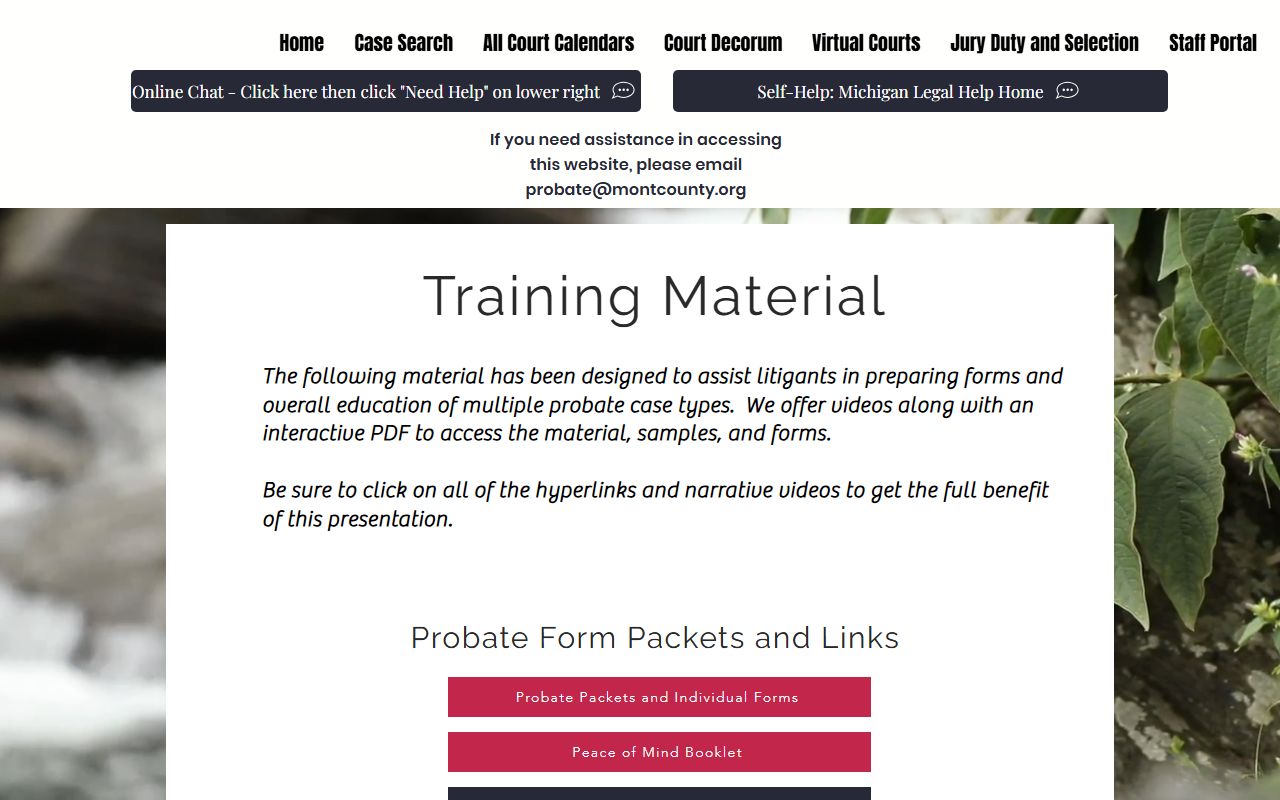
These guides walk first-time filers through common estate and guardianship tasks. They do not replace legal advice, but they cut down on rejected paperwork and repeat trips.
Estates, Wills, and Trusts in Montmorency County Probate
Estate cases make up much of the probate docket. When a person dies with a will, the court probates that will and appoints a personal representative to settle the estate. When a person dies without one, the estate is intestate, and state law decides who inherits. Either way, the representative collects assets, files an inventory, pays debts, and distributes what remains.
Trusts follow a related path. The court can supervise a trust, resolve disputes, and hold a trustee to account. Estate and trust files are often public, so an heir or creditor can usually confirm a case through MiCOURT. For the will itself, an inventory, or an accounting, you contact the office, since those documents do not appear in the online search.
Guardianships and Conservatorships in Montmorency County
Not every probate case involves a death. Many protect a living person who cannot fully care for themselves or manage money. A guardianship covers personal and care decisions. A conservatorship covers finances and property. The court can open either one for a minor or for an adult, including a developmentally disabled adult.
These cases put a fiduciary in charge, and the court keeps watch. Guardians and conservators answer to the judge, file reports, and can be removed for cause. If you need a court-appointed guardian, conservator, or non-attorney guardian ad litem, the probate office keeps a current list. Some details in these files are public, while sensitive personal information is protected.
Restricted Montmorency County Probate Records
Not all probate matters are open. Montmorency Probate Court hears hospitalization and treatment cases for people who are mentally ill, and these are not ordinary public records. Michigan treats mental health proceedings as confidential, so you will not find them in the public case search. Parts of guardianship and conservatorship files can also be shielded to protect a vulnerable person.
Michigan court rules and the state nonpublic-records chart control what stays private. Personal identifiers, such as Social Security numbers and financial account numbers, are redacted or withheld across court records. When a file or a piece of it is restricted, the court releases it only to authorized people or by court order. If you believe you qualify for access, ask the probate office how to request it.
ADA and Hearing Technology
Probate hearings sometimes run with courtroom technology or by Zoom. If a hearing needs a technical setup, or if you need help joining, call the court's technology line at 989-785-8068. The court also posts Zoom instructions and access details with its training materials.
People with disabilities can request accommodations. Fill out the court's ADA accommodation form first, then call 989-785-8068 to confirm your request. Asking early gives staff time to arrange support before your hearing date.
Note: The court advises using the ADA form before you call, so your request is on record when you reach the technology line.
Montmorency County Probate Fees
The Montmorency Probate Court did not publish a local probate fee schedule in its posted materials, so exact filing amounts are not listed here. Fees follow the statewide Michigan courts schedule, and the court collects them through its online tools. Use the channels below rather than guessing at a dollar figure.
| Task | Channel |
|---|---|
| Pay a filing fee | Court credit card payment link |
| Value an estate | Court inventory calculator |
| Confirm the current fee amount | Probate office, 989-785-8067 |
| Request copies or records | probate@montcounty.org or fax 989-785-8065 |
When you file an estate, the inventory value can affect the inventory fee, which is why the court offers a calculator. For marriage, divorce, and other family filings, the Montmorency County marriage and divorce records page and the County Clerk handle records outside probate.